
|
|
The other thing, is it is a play that high school and lower level athletes can handle. Downfield passing and complex schemes are not always easy, but screen passing, and then the adjustments they force the defense to make, or prevents them from making, not only is viable physically for average high school players, it also simplifies things mentally.
As stated before, it allows you to get the ball to your athletes in open space with blockers. It turns an offensive play into a situation like a kick return. Also, those linemen blockers, who are used to blocking guys bigger and stronger then them, now get to attack smaller defensive backs. And with a smart runner, if those defensive backers and people try to sidestep your linemen, your runner should be hitting those holes created. Of course, the linemen should get at least get a good shove in.
Also, especially with the WR screens, it is a way to get the ball to people who maybe you have a harder time getting the football to. Maybe your quarterback can't throw all the routes as consistently, or is young and needs time to grow, at least you can go to these screens to get the ball to playmakers in space.
Finally, these are designed with average linemen in mind, not just college or pro guys with superior size and talent. So asking a guy to block a 3 count then release from the guard position to block the flat defender is something we can't consistantly ask a guy to do.
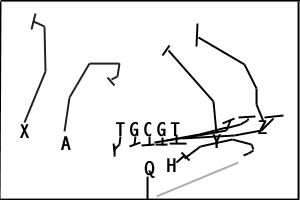
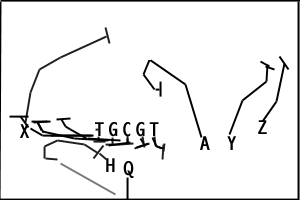
The Screen to the halfback is the first one we install. It can be run from basically any formation, and is our way of getting the ball to who is generally our best athlete year in and year out in space. The quarterback will take the snap and will retreat like on a pass drop, he needs to be conscious to not retreat too fast, because he does not want to be 40 yards back totally giving away that it is a screen. Also, he doesn't want to go too slow and let the defense get to him obviously or make it difficult to deliver the ball. He should keep his eyes downfield or look off the other direction. The receivers will release hard off the ball and will make blocks downfield, hopefully also on the safety. The onside tackle, guard and center will pass set for a one count then release as fast as they can to get in front of the screen. It is hard to be specific on who they block, but the tackle generally has #1 or #2 from the sideline and the center usually peels back to pick up trash. They need to know they can go downfield in high school. The back will fake a pass block set up to his side for a one count and then will release and loop around away from the LOS and curl back to the QB. He will then need to get upfield quickly and follow his blockers.
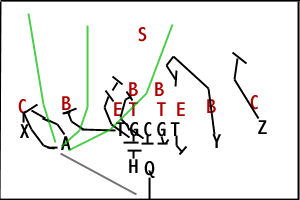
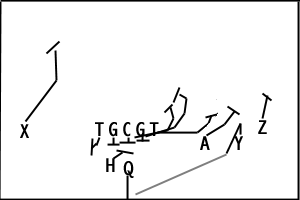
The Wide receiver screen is a personal favorite of mine that we do many times a game with great success. This is a play that has seen increased success and visibility at all levels. The quarterback will drop just as he does on the H screen, and will retreat drawing the defense looking away, and will deliver the ball to the screen receiver after a 5 step drop. The backside receivers will simply run off and try to find someone to hit after a certain depth and selling pass. The running back will simply try to pick up the most dangerous rusher from the linemen that leave. The outside receiver will run up two hard steps and then retrace his steps and begin to come back to the quarterback. He should not get very far in however, and must make sure to be behind the line of scrimmage. Upon catching the ball he must get upfield quickly. The large advantage to the way we do it, and the flexibility we give our blockers, to either reach, come underneath and drive, or kick out the defenders based on where htey are, is it gives our receiver 3 distinctly different paths he can take depending on whatever opens up. It gives you more variation because defenses have different characteristics and adjust differently. The cutback accross the formation happens if the linebackers and safeties way overpursue and the guard and center can come underneath and take those players out of position, but that scenario is rarer. The next closest inside receiver will take one or two hard steps off the line as in a pass route, but then will come underneath and stalk block #1 from the sideline. The onside tackle will immediately release and will try to come underneath and block #2 from the sideline, but can also wall him off and kick him out. The guard and center will pass set up for a one count and then will release and curl up trying to pick up the linebackers/safeties and any other general trash. IN trips, the outside receiver blocks #1 and everything else just moves in one. (the inside man in trips blocks #2 instead of #1, etc.)

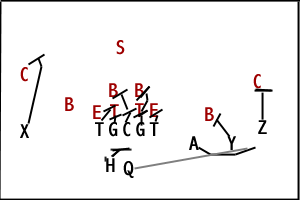
This is one of my favorite plays. However, we never call this in the huddle, it is only used in the no-huddle or as an audible. It is extremely simple. Simply if the flat defender is splitting the difference or if we have some other kind of numerical mismatch we will go to this. The outside receivers will block and the third man(either slot man or back) will release quickly and catch the ball and get to the outside or cut inside the block and get upfield. Moreover, we have to do this a lot to ensure that they are accounting for all our receivers(which is key to pass protection). The outside receiver will block #1 from the sideline, the next receiver will block #2. The onside tackle will punch hard the defensive end to get his hands down. The guard and center will punch hard and then will release downfield to try to pick up pursuit. The QB has to deliver the ball immediately upon receiving the snap, and sometimes out of shotgun this is hard. He doesn't have time to get the laces in all honesty. Just deliver the ball.
| Introduction to the Offense | Pass Protection | 3 Step Passing Game | 5 Step Passing Game |
| Bootlegs | Play Action | Principles and Info | Screens |
| Run Game |
|
Email me at: Chris Brown Main Page Link |