
|
|
The bubble principle that I have mentioned previously is not so much a function of the passing game, it is a function of the run game and pass protection. The whole point is to prevent defenses from putting more people in the box than you can account for or at least easily process and organize assignments. This keeps the defense to usually only 5 or 6 defenders, a reasonable number, and it lets you analyze based on safeties. Providing you have checked out the bubble rule, and have noticed any defensive shifts or safety/CB blitzes if you see 2 safeties they should not be able to put more than 5 defenders in the box. Moreover, you can look at their coverage, cover 2, 3 etc and it can immediately tell you whether a run or pass is advisable based on down or distance. Obviously because the numbers are more favorable, we like to run the ball a lot more versus cover 2 or cover 4 than we do 3 or 1, because of the extra defender in the box.
Next, I wanted to get the receiver blocking rules out of the way. The outside receivers have a few simple rules that apply to all our runs. The first is if it is an inside running play, and the defender over you is deeper than 5 yards, block him and stalk his inside shoulder. If he is shallower than 5 yards, accelerate past him and try to hit the safety before the runner can get there. If it is an outside run to you, block the man over you no matter what, if he is shallower than 5 yards be cautious of him shooting inside you to make a tackle for a loss, but otherwise try to stalk his outside shoulder attempting to give the runner the sideline. Moreover, by doing this, he will often widen so if you can't you can just shove him out of bounds and it still leaves a big alley. If the play is to the outside and away the receiver will try to cut off the safety.
The slot receivers only rule is to block the man over them, however he has to be mindful of where the play is going so he knows whether to straight ahead drive or which shoulder to take.
It should be noted that while we don't have a true outside stretch or sweep the receivers block option as an outside run. We do this because we weren't getting good angles from the shotgun, and we already throw bubble screens and flat passes, and screen and pitch on the option, and felt like we didn't need it any longer and we still try to and succeed at putting a lot of pressure on the edges with out a true sweep, stretch or toss.
On all handoffs the QB's job is not over, he should boot out, fake dropping pack to pass and even throwing fake psses a la Brett Favre. It really does work.
Also, you'll notice I do not draw a specific path on a lot of our runs because I feel it is difficult to accurately predict a lot of times where the defense will line up and how they will stunt and things, and instead of giving our players a lot of confusing rules regarding this, we preach to our blockers to get a hat on someonbody and crush them and our runner to find the hole or seam and get positive yards. However, while we give the runner freedom, we also work hard to discipline them and we want them going north and south most of the time, not dancing, especially not in the backfield. It is more of a one decision or one cut, and go.
The last note, and I have mentioned this, is that we will do a formation or personel group(depending who our best blocking types are) and it will look just like our doubles formation except our slots will be in a 2 point stance with their feet parrallel, in a football stance, one yard outside the tackle and one yard back. All the rules stay the same, but it gives us a chance to substitute bigger people and better blockers if they aren't already out there and gives us more of a power set.
When scouting and looking to run the ball we look for what their alignments are, but for the most part we look for personel and attempt to find who we can run against, both on the defensive line and as far as linebackers. Basically we look for people to pick on. That is our biggest criteria. (It should be noted, that a lot of teams try to hide their weaker defenders by surrounding them with the best defenders. For example a weak defensive linemen might have the best linebacker behind him, or they might do it with numbers by bringing up a safety. So even if you're running vs the weakest defender, are you getting yards?)
When I get the chance I will diagram the quarterback runs that we use when we have the quarterback for it.
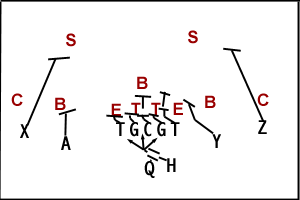
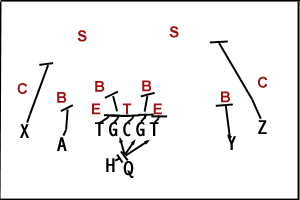
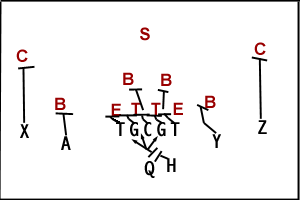
Our base play and the run play we use the most often. The inside zone is a favorite of ours because it is totally a drive blocking play but also gives our running back to find the hole, but once he does, he is going north and south.
We want to take medium splits, so there isn't a lot of overlapping as far as rules but we don't want to allow penetration. The rule for all of the linemen is to block the man on, over or inside you. If he is over you will lateral step first and then drive, if over you just fire out into his chest and inside you just block down upon him. If uncovered, you will combo the nearest defensive linemen to linebacker. Some teams free release those linemen, but we want to crush the defensive line if at all possible and control the line of scrimmage, but they do have to be careful not to waste too much time with the defensive linemen before releasing.
The quarterback will take the handoff and reach the ball in front of him. The RB will step at an angle in front of the quarterback and will take the handoff with his eyes forward. It is the quarterback's job to get the ball to him. Once he sees where he wants to go, he will plant hard and accelerate.
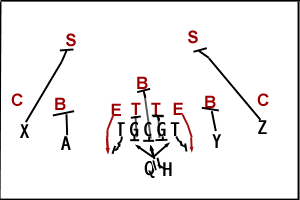
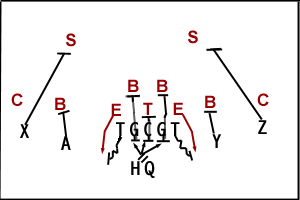
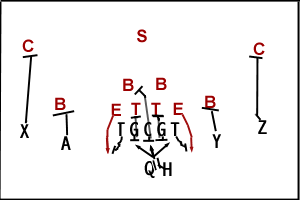
The draw is an underrated run play in my opinion. Especially from the shotgun. Anyway, the tackles will set up and basically pass protect and try to force the defensive ends wide and let them take themselves out of the play. The three interior linemen will do a short pass set up then block either the linemen over them or if uncovered will release downfield and block the most dangerous second level player, which is usually either the middle backer or the strongside backer.
The QB will take the snap, then raise the ball high in pass position(don't exaggerate, a lot of coaches think if defenders see anything they'll jump, they really do notice when it is exaggerated) and then will lower and put the ball in the runner's pocket. The runner will step laterally towards the sidelines and then stepback towards the QB, take the handoff, then "run to daylight".
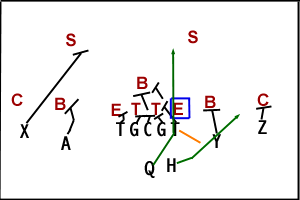
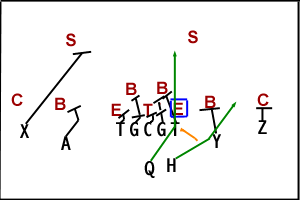
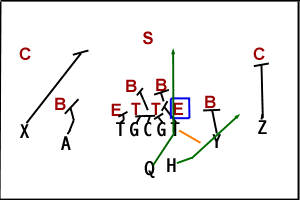
The option is a powerful tool that we are glad to incorporate in our offense, though the level of emphasis each year depends upon the players we have.
The playside defensive end is the player we are optioning, and as a result the playside tackle and guard will block down on the next closest interior defender, usually the defensive tackle, and the tackle will combo to backer. Versus the odd front diagrammed above it takes on a slightly different personality, but the rules mostly remain the same. The center, guard and tackle will step inside to seal to prevent pentration and the uncovered one will then release onto the backside or middle backer. The quarterback will attack the defensive end's outside shoulder in an effort to make him commit and he will pitch it if he thinks the defensive end can tackle him. We used to use moire archaic rules like if he sits or steps laterally etc, but when we turned it to that the quarterbacks became more comfortable with the idea. We do strongly warn him that if the end does tackle him and he didn't pitch, he will have some explaining to do. The H will step laterally and then will maintain the proper pitch relationship expecting the ball at any time, especially the quick pitch. We've often had the qb take the snap, take one step and be forced to pitch. If he receives the pitch he will try to hit the sideline based on the blocks of the receivers.
Note: If the QB keeps the ball the back must maintain pitch relationship. It is not uncommon for the quarterback to clear the DE and pitch to the RB based on the free safety. No reason for him to let up when he could have a potential touchdown.
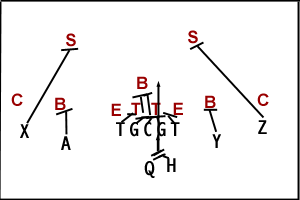
Our wedge play is very simple, and it is more of an attempt to just fire out and get four yards no matter what.
We honestly don't really have to know what defense they are in, we usually will just try to run this where there are fewer defenders. The guard will just fire out straight, and the center and playside tackle will pinch down and try to fire out as well, the backside guard's job is basically the same but it is unlikely he will touch shoulders as the frontside 3 do, and the backside tackle will release and find someone downfield to block. The back will step laterally and then upon receiving the handoff will explode forward, lowering his shoulders. There is no reason this play should not get four yards. The QB will give him the ball immediately upon receiving the snap.
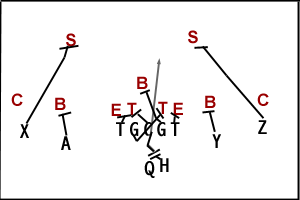
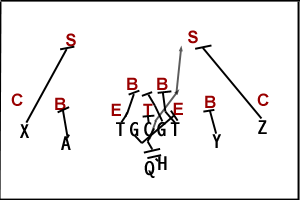
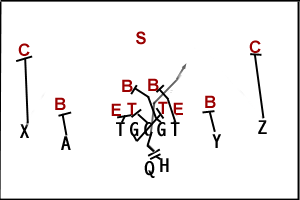
The trap is our most complicated run play, we still try to keep this simple and it is often very effective, especially versus aggressive defenses.
We try to run this to the widest "3" if you use Bear Bryant's defensive technique numbering system. if you do not, basically the player outside the guard that is widest. So this play gets audibled a fair bit. If we line up and one defensive tackle is heads up our guard and the other one is an outside shade, we will try to run the trap to the outside shade. The playside guard will release inside and block the linebacker. Versus an even 4 defensive linemen front with only 5 in the box(2 safeties), the tackle will block the linemen over him, and release inside to seal. Versus an even four man defensive front with 6 in the box (1 safety) or an odd(odd for us is anything with a nose basically)with 5 or 6 in th ebox he will inside release and block the linebacker expecting the back to cut under him.
The backside guard will pull and trap first color outside of the center. The center will block the man over the guard or if he has a nose he will fire straight out. The backside tackle will help with the man over the backside guard and will then release to linebacker/downfield. The quarterback will hand it off to the back making sure to put it in his stomach. The back will begin just like the inside zone, then will plant and cut, following the trapping guard and cutting off of his block looking for a seam and making sure to accelerate.
| Introduction to the Offense | Pass Protection | 3 Step Passing Game | 5 Step Passing Game |
| Bootlegs | Play Action | Principles and Info | Screens |
| Run Game |
|
Email me at: Chris Brown Main Page Link |